
Frequently asked questions about the levy and district
Don't see your question answered below? Send us an email.
About Proposition 11
How much would it cost me?
For a $650,000 home, the levy would be $95 per month. The estimated annual rate is $1.76 per $1,000 of assessed value.
The actual rate will depend on the amount of new construction in the district. If new homes are built within the district's boundaries, the total amount would be spread out among more taxpayers and the rate would decrease.
How would the Battle Ground tax rate compare to other districts?
If the levy passes, Battle Ground residents’ tax rate for local schools will be an estimated $2.21. The average tax rate for local schools in Clark County is $3.20. See a comparison of local tax rates for 2026. Battle Ground is the only district without this type of levy. If approved, the new levy would start in 2027.
Is this an added tax?
Property owners are not paying taxes for this type of levy in 2026. The last time that taxpayers paid for an educational programs and operations levy was in 2025. If this levy is approved, taxes would start in 2027.
How much money would the levy bring to BGPS schools?
If approved, the levy would bring in the following amounts over three years:
$37.03 million in 2027
$38.69 million in 2028
$40.43 million in 2029
By law, the district cannot collect any more than the amount that voters approve.
How did the district decide on the amount?
Using input from community members, parents, staff and students, the district developed four potential amounts for the school board to consider.
Option 1: $26.82 million in first year / estimated rate of $1.28
Option 2: $37.71 million in first year / estimated rate of $1.79
Option 3: $38.96 million in first year / estimated rate of $1.86
Option 4: : $42.59 million in first year / estimated rate of $2.03
After reviewing the cost, community input, economic conditions and outcomes related to each option, the board decided on an amount and rate slightly below option 2:
$37.03 million in first year / estimated rate of $1.76
How does this levy compare to previous levy attempts?
Year of tax collection | February 2025 | April 2025 | February 2026 | November 2026 |
|---|---|---|---|---|
2026 | $38.30 million / $1.95 estimated rate | $38.30 million / $1.95 estimated rate | N/A | N/A |
2027 | $40.40 million / $1.95 estimated rate | $40.40 million / $1.95 estimated rate | $43 million / $1.99 estimated rate | $37.03 million / $1.76 estimated rate |
2028 | $42.60 million / $1.95 estimated rate | $42.60 million / $1.95 estimated rate | $45.80 million / $1.99 estimated rate | $38.69 million / $1.76 estimated rate |
2029 | $44.98 million / $1.95 estimated rate | $44.98 million / $1.95 estimated rate | $48.77 million / $1.99 estimated rate | $40.43 million / $1.76 estimated rate |
2030 | N/A | N/A | $51.94 million / $1.99 estimated rate | N/A (the proposed levy is for three years, not four) |
How did the district decide what would be included in the levy?
Input by community members, parents, staff and students helped the district understand the priorities. See the input. In addition, district leaders reviewed prior community input on budget cuts.
Would the levy bring back all of the things that were cut?
The district will not be able to return all of the programs, positions and services that have been cut over the past two years. The restored items would be based on community input collected through surveys, listening sessions and other methods. Additional budget cuts may still be needed in future years due to rising costs.
Are tax exemptions available?
Yes. Some people may be eligible for a property tax exemption. Learn more.
District finances and state funding
What does the state pay for?
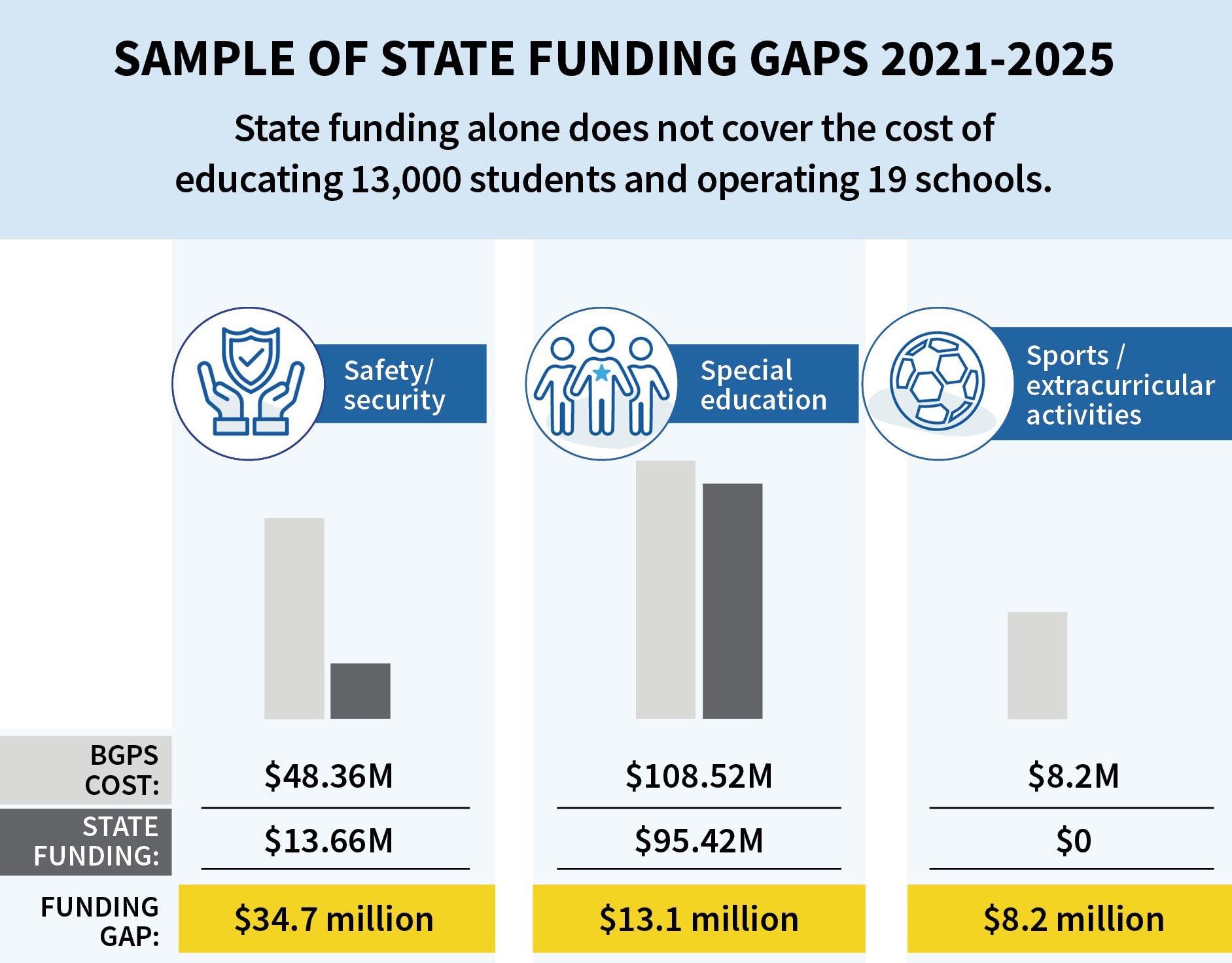
State funding provides much of the district’s budget. However, state funding does not fully cover the cost of things like safety and security, special education, career and college preparation classes, mental health services, the arts, sports and more.
As Washington state’s operating budget has increased, the percentage that goes toward funding K-12 education has decreased. In 2019, 51.6% of the state’s budget was dedicated to K-12 education. By 2025, it had decreased to 43.23%. Learn more.
How much do unfunded state compliance requirements cost the district?
Funding has not kept pace with state requirements. Recent mandates and requirements now represent tens of millions in costs for which the district does not receive state money. This puts pressure on the district's budget. See an analysis of these costs.
Why have district costs increased?
Costs have gone up because there are more students attending school in the district. Enrollment has increased more than 10% since the 2021-22 school year (source: OSPI report card). More students means increased staffing and operating costs.
At the same time, the cost to operate schools and meet state requirements also has gone up. For example, in a five-year span:
Insurance costs rose 84%
Utilities increased 30%-60%
Supply costs grew by 31%-68%
Why is the district asking for $37.03 million in the first year if it only cut $34 million over the past two years?
To limit the amount of budget cuts and cover costs, the district used millions from its savings (also known as a fund balance), which is one-time money. Continued use of savings to cover regular costs is not sustainable. In addition, board policy requires an unassigned minimum fund balance of 4% to 6% of budgeted expenditures.
We've been told that there was a $34 million cut. What is the percentage of the entire budget?
Prior to its expiration, the local education levy supplied about 13% of district revenue. Following the levy failures, Battle Ground cut $34 million over two school years. By the end of that two-year period, those reductions amounted to roughly 15% of the district’s annual operating budget before the loss of levy dollars.
The district has also been spending down its reserves, or fund balance, to cover millions more in annual expenses. In 2026-27 alone, even after an additional $20 million in cuts, the district is still using about $14 million from reserves to balance the budget.
How can I see the district's financial information?
BGPS provides financial information on its website, during public school board meetings and in publicly available reports submitted to the state of Washington. In 2026, Battle Ground Public Schools passed a financial audit by the Washington state auditor’s office.
What does the audit include?
Audits include hundreds of hours of review by staff from the Washington state auditor's office. They assess whether an organization is complying with applicable laws, regulations and policies and maintaining appropriate controls to safeguard taxpayer money and assets.
Do developers pay money toward schools?
Yes. Impact fees paid by developers and new home owners go toward schools. However, these fees can be used for only facility projects listed in the approved capital facilities plan. They cannot be used for operating costs.
How is the district able to build new buildings without a levy?
School districts use different sources of money to pay for capital/building projects. Generally speaking, these sources of money cannot be used to pay for day-to-day school operations such as salaries/benefits, utilities, supplies, curriculum, etc. Learn more about funding for capital facility projects.
How much does Battle Ground spend per student on average?
Battle Ground spent $18,168 per student in the 2024-25 school year. Learn more about this amount.
Why does Battle Ground spend that amount per student?
Public schools serve each and every student who attend them. Services such as buses, meals, special education and health monitoring are all part of what public schools provide for students. These services cost money. Private and home schools may not offer the same range or level of services as public schools do. Some students who attend private schools receive services from public school districts such as speech therapy, special reading or math help or other support. Some students who are homeschooled take classes and/or play sports in public schools. Public schools educate students with many different needs and serve the wider community.
How much do school board members make?
Board members do not receive any compensation when the district does not have an educational levy. When the levy is in place, the maximum amount that a board member may receive is $4,800 per year. Any board member may waive some or all this amount. Some board members choose to donate their compensation to the Battle Ground Education Foundation.
Does Battle Ground have more district administrators than other districts of a similar size?
In other Washington state districts with 10,000 to 15,000 students, the average number of district administrators is 33. Battle Ground has 13,000 students and 21 administrators.
Could BGPS harvest timber on current property to provide funding and have students from CASEE assist with replanting, care and upkeep? It could provide funding and education to students while reaching into one of WA's local resources.
Thank you for this suggestion. Timber harvesting is traditionally contracted out to professionals with the knowledge, skills and equipment. Any proceeds would be after contracting for this service and paying taxes and other costs to sell the timber. Any proceeds would be one-time funds. In addition, the Department of Natural Resources owns the land on the CASEE campus and would retain any timber proceeds.
WA state levies
What is the difference between a levy and a bond measure?
In general, levies provide for learning, maintenance and operations. The district's capital levy pays for minor building repairs, safety improvements and some technology.
Bonds go toward buildings. Battle Ground voters last approved a bond in 2005 to finance the construction of several new schools, additions and improvements. That bond expired at the end of 2023.
How often can the district run a levy?
State law allows two attempts per calendar year.
How many WA state districts have levies?
The following map from OSPI shows local levy funding. Battle Ground is the only district with more than 10,000 students that does not currently have an educational programs and operations levy.
WA state requirements
Are all state requirements fully funded?
No, they are not. Schools are required by law to do and report hundreds of things without resources to support these mandates, which strains district budgets. Failure to meet these requirements may require a district to undergo additional state monitoring, operational changes and/or restricted or redirected state funding.